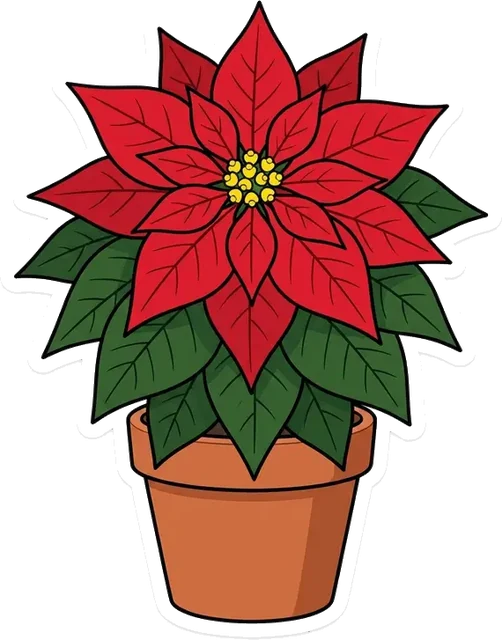
Poinsettia care: how to keep it alive and make it red again
Keep a poinsettia indoors near a bright window at 16–21 °C (60–70 °F), away from radiators and draughts, and water it when the surface of the soil feels dry. To make it turn red again next year, give it at least 14 hours of total darkness every night from early October until the bracts colour up. It’s mildly toxic to cats and dogs: the sap irritates the mouth and stomach.
Updated 12 October 2026. How we write these pages
Poinsettia: indoors or outside?
Indoors, near a window
Yes
With at least 6 hours of natural light a day and a room at 16–21 °C (60–70 °F), it stays looking good for weeks.
Near a radiator or a door
No
Warm, dry air, cold draughts and sudden changes in temperature make it drop its leaves.
Outside
Only in summer
Once the nights stay above 13 °C (55 °F). Bring it back in as soon as they start dropping below that.
Why a poinsettia turns red
The red parts are coloured leaves called bracts. The real flowers are the small yellow-green buttons in the middle.
The bracts colour up after several weeks of long nights like those of autumn, and a lamp left on in the room in the evening is enough to stop them. To make yours red again, from early October keep it in total darkness for at least 14 hours every night, say from 5 pm to 8 am in a cupboard or under a box, in a room at 16–21 °C (60–70 °F). Put it back by the window during the day.
Stop once the bracts start to colour, usually between late November and early December.
How to care for a poinsettia indoors
Water
When the surface feels dry.
Water until it runs out of the holes, then empty the saucer. If the pot is wrapped in foil, take it off or make a hole in the bottom.
Light
At least 6 hours a day.
Natural light, near a window. Don’t let the leaves touch the cold glass.
Cold
A moment of frost is enough to ruin it.
The leaves and bracts blacken and drop. Bring it home wrapped, and don’t leave it in a cold car.
Questions about poinsettias
How do you get a poinsettia to rebloom?
After the holidays, keep watering it when the surface is dry. Between late March and early April, cut the stems back, leaving 3 or 4 leaves on each. It can go outside for the summer, and until the end of August pinch out the tips of the new shoots. From early October, give it at least 14 hours of darkness every night until the bracts colour up.
When should you put a poinsettia in the dark?
From early October. Every night it needs at least 14 hours of total darkness with no light at all, in a cupboard or under a box, say from 5 pm to 8 am. During the day put it back near a bright window. Keep going until the bracts start to colour, usually between late November and early December.
How often should you water a poinsettia?
There’s no set number of days. Feel the soil every day and water when the surface is dry, until it runs out of the holes. In a terracotta pot that happens more often, and in plastic it’s easy to give it too much.
Why is my poinsettia dropping leaves?
Look at the soil. If it’s soggy, the lower leaves turn yellow and fall, so empty the saucer and wait for the surface to dry. If it’s dry, the plant wilts and drops leaves, so water it. Cold draughts, warm air from a radiator and sudden temperature changes near a door make it drop leaves too.
How do you care for a poinsettia in summer?
Once the nights stay above 13 °C (55 °F) it can go outside. Keep it in the shade for two or three days, then move it somewhere with 6–8 hours of sun. Water when the surface is dry, and pinch out the shoot tips once or twice before the end of August so it stays bushy. Bring it in when the nights drop below 13 °C (55 °F).
How do you prune a poinsettia?
Between late March and early April, once the bracts have faded, cut the stems back to 10–15 cm (4–6 in) above the soil, leaving 3 or 4 leaves on each. In summer pinch out the tips of the new shoots, the last time at the end of August. Wear gloves, because the milky sap that runs from the cuts irritates the skin.
Are poinsettias toxic to cats and dogs?
Mildly. If they chew one, the sap irritates the mouth and stomach and sometimes makes them sick, but it rarely goes further than that. Keep it out of their reach, and call the vet if they’ve eaten a lot.
Read next
Every plant has its own rhythm. LINFA keeps track for you.
It looks at the light where your poinsettia stands, its pot and the season, and tells you when to check it.
Coming soon to Android