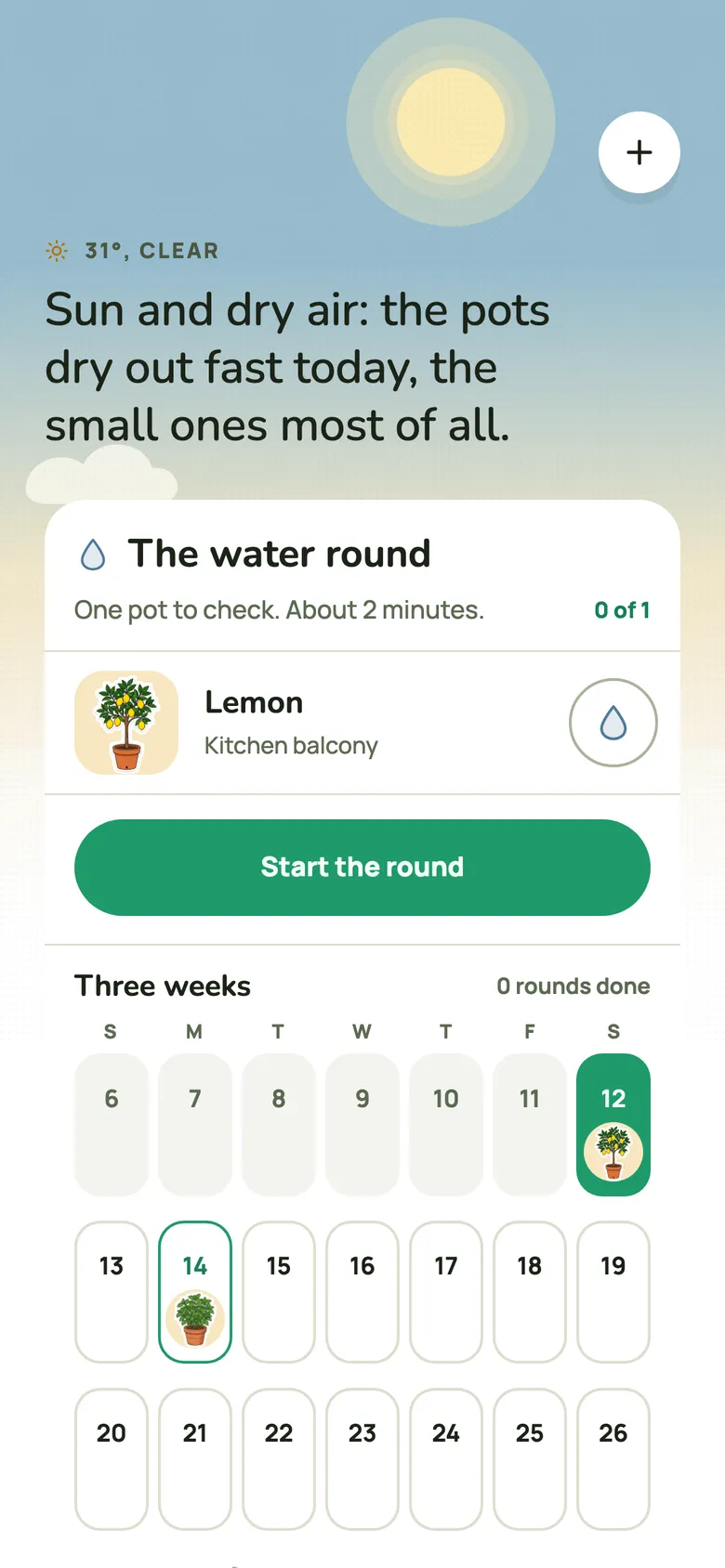
Spider plant
Chlorophytum comosum, herbaceous, evergreen
Water a spider plant when the soil has dried out completely, which indoors means every 5–10 days in summer and every 7–14 in winter. It wants plenty of light but not the hot midday sun, and starts to suffer below 5 °C (41 °F).
Updated 12 October 2026. How we write these pages
Spider plant at a glance
Water, indoors
5–10
days in summer
7–14
days in winter
When the soil has dried out completely.
Month by month
Minimum temperature
1–5 °C
It starts to suffer between 1 and 5 °C (34–41 °F).
Cats and dogs
Not toxic to dogs or cats.
Eating a lot of it can still upset their stomach.
Growth
Steady.
Feeding
Quite a lot while it’s growing.
Follow the dose and frequency on your fertiliser’s label.
Repotting
When the roots fill the pot.
Pruning
Remove faded flowers.
Where does your plant live?
Pick its place and see what changes.

What changes
- Indoors, near the window. The light is right, as long as the hot midday sun doesn’t hit the leaves through the glass.
- Indoors, away from the window. With less light it grows more slowly and new leaves come in smaller. If you can, move the pot closer to the window.
- Outdoors, in the shade. This suits it: outdoors, bright shade is the light it likes best.
- Outdoors, in the sun. Full sun scorches its leaves, so move the pot into the shade, at least for the hottest hours.
- Indoors, summer. In July it usually needs water every 5–10 days, and only once the soil has dried out completely.
- Indoors, winter, heating on. In January it usually needs water every 7–14 days. Near a radiator the soil dries faster, but wait until it has dried out completely.
- Indoors, winter, cool room. In January it usually needs water every 7–14 days, and less often in a cool room, where the soil stays damp for a long time.
- Outdoors, summer. Outside the soil dries faster than indoors, where in July it needs water every 5–10 days, but still wait until it has dried out completely.
- Outdoors, winter. It starts to suffer below 5 °C (41 °F). On the coldest nights, move the pot under shelter or indoors.
- Outdoors, winter. In the cold the soil stays damp for a long time, so it needs water less often than indoors, where in January it needs water every 7–14 days.
How often to water a spider plant
Indoors, month by month. Tap a column.
In October
Every 6–13 days
Usually every 9 days. Feel the soil first, and water only when it has dried out completely.
Every month in a table
| Month | Usually | Usually between |
|---|---|---|
| January | every 10 days | 7–14 days |
| February | every 10 days | 7–14 days |
| March | every 9 days | 6–13 days |
| April | every 8 days | 6–12 days |
| May | every 7 days | 5–10 days |
| June | every 7 days | 5–10 days |
| July | every 7 days | 5–10 days |
| August | every 7 days | 5–10 days |
| September | every 8 days | 6–12 days |
| October | every 9 days | 6–13 days |
| November | every 10 days | 7–14 days |
| December | every 10 days | 7–14 days |
Typical intervals indoors in the northern hemisphere: light, the pot and the season stretch or shorten them. How to tell when to water, with a finger and the weight of the pot.
Soil, propagation and problems
Soil
An all-purpose potting mix that holds a little moisture but drains well: if it’s very dense, add some perlite. It likes it neutral or slightly acidic.
Propagation
By division: when you repot it, split the plant into pieces that each have their own roots.
Common problems
The most frequent: Aphids · Root rot · Scale insects · Spider mites · Whiteflies
When you feel the soil, look under the leaves too: pests show up there first.
Spider plant: good to know
Spider plant tip burn often comes from fluoride.
Usually at least a year old before babies. More babies when slightly pot-bound.
Spider plant: questions and answers
How often should you water a spider plant in winter?
Indoors in January, usually every 10 days (between 7 and 14), compared with every 7 in July. The longest gaps run from November to February.
How can you tell when a spider plant needs water?
Only when the soil has dried out completely, right to the bottom of the pot.
How much light does a spider plant need?
Plenty of light, without the direct midday sun, which can scorch the leaves. Indoors it does well near a bright window, and further from the window it grows more slowly.
Is a spider plant toxic to cats and dogs?
Not toxic to dogs or cats. Eating a lot of it can still upset their stomach.
How much cold can a spider plant take?
It starts to suffer from the cold somewhere between 1 and 5 °C (34–41 °F). Outdoors, on nights below 5 °C, move the pot under shelter or indoors.
When should you repot a spider plant?
When the roots fill the pot. There are usually 1 to 3 years between repottings.
How do you prune a spider plant?
Cut back the flower spikes once they have finished. Leave them if you want the new plantlets.
How can you tell if a spider plant is getting too much water or too little?
Too much water often shows as leaves turning yellow, soft brown patches on the leaves and leaves drooping even though the soil is wet. Too little shows as leaves still drooping in the morning and leaves starting to curl or fold.
What soil does a spider plant need?
An all-purpose potting mix that holds a little moisture but drains well: if it’s very dense, add some perlite. It likes it neutral or slightly acidic.
How do you propagate a spider plant?
By division: when you repot it, split the plant into pieces that each have their own roots.
Which pests and diseases affect a spider plant?
The most frequent are aphids, root rot, scale insects, spider mites and whiteflies. When you feel the soil, look under the leaves too: pests show up there first.
Why does my spider plant have brown tips?
Often it’s the fluoride in tap water, which spider plants are sensitive to. Dry air near a radiator, soil left dry for too long or too much fertiliser can cause it too. Water with rainwater or distilled water and keep it away from the heat. Tips that have already gone brown won’t turn green again, so trim them off with scissors if you like.
How do you root spider plant babies?
Rest a baby on the soil of a small pot next to the mother plant, still attached, and hold it down with a bent piece of wire. Once it has rooted, cut the stem that joins them. A baby that already has its first roots can also be cut off and potted straight into damp compost.
Can a spider plant grow in water?
A baby can, while it roots. Cut it off, sit it in a glass of water with the leaves above the water, and change the water when it turns cloudy. Once it has roots, pot it up in compost.
Why isn’t my spider plant making babies?
A plant usually needs to be at least a year old, and it makes more once the roots fill the pot. The babies come after a few weeks of short days and long, dark nights, which is why they often appear in autumn. Too much fertiliser means fewer of them.
Why are my spider plant’s leaves turning yellow?
Often it’s too much water: the soil stays wet and the roots suffer. Wait until the soil is dry before you water, and empty the saucer. If only the tips are drying out, the cause is usually tap water or dry air.
Can a spider plant live in low light?
Yes, it copes with a corner away from the window or a north-facing room. There it grows more slowly and drinks less. What it can’t take is the hot midday sun, which scorches its leaves.
Read next
Every plant has its own rhythm. LINFA keeps track for you.
It looks at the light where your plant stands, its pot and the season, and tells you when to check it.
Coming soon to Android