Orchid care: how to water an orchid and make it rebloom
Water a moth orchid (Phalaenopsis), the most common orchid in homes, by soaking its pot of bark in tepid water and letting it drain completely: usually once a week while it’s growing and a little less in winter, when the roots turn from green to silvery. To make it rebloom, cut the stem just above the second node below the flowers once they’ve all fallen, and if it hasn’t flowered for a while, keep it somewhere 5 °C (9 °F) cooler for about a month. It isn’t toxic to cats or dogs.
Updated 12 October 2026. How we write these pages

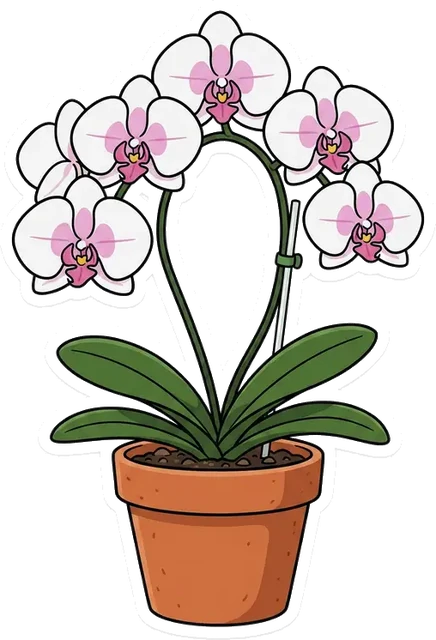
How to make an orchid rebloom
Once all the flowers have fallen, cut the stem just above the second node below them, one of the small joints along the stem: a new flowering side shoot may grow from there. If the whole stem turns pale and dry, cut it off at the base.
To grow a new flower stem, a moth orchid needs a cooler spell. In winter most homes are cool enough. If yours is kept warm and hasn’t flowered for a while, move it somewhere 5 °C (9 °F) cooler for about a month: in trials, a constant 29 °C (84 °F) stopped new stems altogether, and warm days held flowering back as much as warm nights.
It needs light too. Keep it near an east- or west-facing window, shaded from direct summer sun: with too little light it flowers poorly or not at all.
How to water an orchid
When
When the roots turn silvery.
In a clear pot the roots look green just after watering and silvery once the bark dries. Don’t let it dry out completely.
How
Soak it, then let it drain.
Run tepid water through the pot for half a minute, or stand it in a bowl of water, then let it drain well. Don’t leave it sitting in water in the saucer.
Where not
In the middle, between the leaves.
If water sits in the heart of the plant, dab it out with kitchen paper, because it can rot there. Water in the morning so the leaves dry before evening.
Questions about orchids
How often should you water an orchid?
In bark, usually once a week from spring to autumn and a little less in winter. Look at the roots: when they turn from green to silvery, it’s time. Moss holds water for longer, so in moss water when the surface feels dry.
Can you water an orchid with ice cubes?
Better not. A few ice cubes don’t wet all the bark, and the roots of a tropical plant want tepid water.
Why are my orchid’s leaves turning yellow?
If only one lower leaf, the oldest, turns yellow, that’s normal: each year one or two new leaves grow at the top and the old ones at the base die. Leave it until it comes away on its own. If several leaves turn yellow, look at the roots: brown, mushy roots mean it’s had too much water.
What do you do with orchid roots growing out of the pot?
Nothing, they’re normal. In the wild moth orchids grow on tree branches, and those roots help them cling on and take in moisture. Don’t cut them off or bury them.
What do you do with an orchid after the flowers fall off?
Cut the stem just above the second node below the flowers and keep watering as before. If the stem turns yellow and dries, cut it off at the base: a new one can grow from among the leaves after a cooler spell.
When should you repot an orchid?
About every two years, or sooner if the bark is breaking down or the plant has outgrown its pot. Do it when the roots have green tips, a sign they’re growing. Use orchid bark, never multipurpose compost, and a clear pot only just bigger than the roots.
Where should you keep an orchid indoors?
Near a bright window, out of direct summer sun, away from radiators and draughts: it suffers below about 15 °C (59 °F). It likes humid air, so stand it near other plants or on a tray of wet pebbles, with the bottom of the pot above the water.
Are orchids toxic to cats and dogs?
Moth orchids aren’t: Phalaenopsis is non-toxic to both cats and dogs. For other orchids, check the plant’s exact name.
Read next
Every plant has its own rhythm. LINFA keeps track for you.
When the flowers drop, your orchid’s pruning guide shows you where to cut the stem.
Coming soon to Android